The 5 Best AI Tools for Freelance Writers in 2026
Compiled by AI for My Craft · Last updated · pricing re-verified continuously
TL;DR: The best AI tools for freelance writers right now are Jasper, KoalaWriter, Grammarly — full comparison, verified pricing and honest limitations below.
For freelance writers, AI is either a threat or a multiplier depending entirely on how you use it. The writers thriving in 2026 use AI for the parts clients don't pay premium rates for — first drafts, outlines, research summaries, paraphrasing — and keep their own voice and judgment as the product.
The five tools below cover distinct jobs: marketing copy at volume, SEO drafts, fiction, correctness, and quick rewrites. Most writers need one or two, not all five. Prices were verified on the date shown and this page is updated when plans change.
Find your tool in 10 seconds
1. Your budget?
2. What do you want to solve first?
Quick comparison
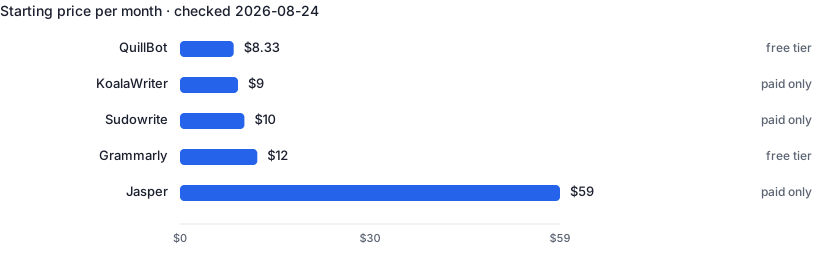
| Tool | Best for | Free tier | Paid from ↕ |
|---|---|---|---|
| Jasper | Repeatable marketing copy with a consistent brand voice | No | $59/mo |
| KoalaWriter | One-click SEO blog drafts grounded in live search data | No | $25/mo |
| Grammarly | Error-free client-facing communication with zero workflow change | Yes | $12/mo |
| Sudowrite | Novelists and fiction writers fighting blank-page paralysis | No | $10/mo |
| QuillBot | Quick paraphrasing and summarizing without a big subscription | Yes | $8.33/mo |
1. Jasper — AI writing assistant built for marketing and business copy
Jasper is one of the longest-running AI writing platforms, aimed at marketing copy rather than general chat. It ships with templates for product descriptions, ads, emails and long-form articles, supports brand-voice training so output matches your existing tone, and includes a plagiarism checker integration. For professionals who write the same type of copy repeatedly — listings, job ads, newsletters — the template workflow is noticeably faster than prompting a general chatbot from scratch.
- Brand-voice training keeps output consistent across documents
- Large template library for specific copy formats
- Team features and SEO-mode integration with Surfer
- Pricier than a general chatbot subscription
- Output still needs human editing for factual claims
2. KoalaWriter — Purpose-built AI writer for SEO-optimized long-form articles
KoalaWriter turns a keyword into a full, structured blog post in one click: it analyzes the live SERP, pulls real-time factual data and generates an SEO-optimized draft with headings, images and — on higher tiers — automatic internal links. Built for publishers and SEO writers rather than short marketing copy, it publishes straight to WordPress, Shopify, Webflow and Ghost. The output still needs a human editing pass for voice and fact-checking, but it produces publishable long-form faster than prompting a general chatbot from scratch.
- Generates full-length, SEO-structured articles from a keyword in one click
- Real-time SERP and factual-data grounding reduces outdated or invented facts
- One-click publishing to WordPress, Shopify, Webflow and Ghost; you own all output
- Automatic internal linking and deep research are locked to the $49/mo Professional tier
- Word credits drain twice as fast when using the strongest models (GPT-5.2 / Claude)
- Built for long-form SEO articles — not for short marketing copy, fiction or non-article formats
3. Grammarly — Grammar, tone and clarity checking everywhere you type
Grammarly sits on top of whatever you already write in — email, docs, ATS forms, browsers — and flags grammar, clarity and tone issues in real time. The Pro tier adds full-sentence rewrites, tone adjustment and generative drafting. For professionals whose credibility depends on polished client-facing writing, it is the lowest-friction AI tool on this list: install once, benefit in every text field.
- Works inside the tools you already use
- Excellent free tier for basic correctness
- Tone detection helps calibrate sensitive emails
- Suggestions can flatten a distinctive writing voice
- Generative features are weaker than dedicated AI writers
4. Sudowrite — AI writing partner designed specifically for fiction
Unlike general-purpose AI writers, Sudowrite is built for narrative prose: it offers scene expansion, sensory description generation, character-consistent dialogue suggestions and a story-bible feature that keeps long manuscripts coherent. Fiction writers use it to push past blocks and generate variations of a scene rather than to auto-write whole chapters. It deliberately avoids the corporate-copy feel of marketing-oriented tools.
- Purpose-built features for narrative and description
- Story bible keeps characters and plot consistent
- Non-judgmental brainstorming for stuck scenes
- Credit system penalizes heavy daily use
- Not useful for non-fiction or business writing
5. QuillBot — Paraphrasing, summarizing and grammar tools at a low price
QuillBot started as a paraphraser and has grown into a small suite: rewriting in multiple modes, summarizing long documents, grammar checking and citation generation. Writers use it to rework awkward sentences; teachers use the summarizer to condense readings and the plagiarism checker to spot copied work. It is significantly cheaper than full AI writing platforms while covering the most common editing tasks.
- One of the cheapest paid AI writing tools
- Summarizer handles long documents well
- Multiple paraphrase modes from formal to creative
- Paraphrases can drift from the original meaning
- Not designed for generating content from scratch
Frequently asked questions
Will clients find out I use AI, and does it matter?
Increasingly, clients assume some AI involvement and care about the result. What damages trust is submitting unedited AI output — it reads generic and can contain invented facts. Disclose if asked, edit always.
Which tool is best if I can only afford one?
For SEO blog and article work, KoalaWriter delivers the most publishable output per dollar and drafts long-form in one click. For fiction, Sudowrite is the only serious purpose-built option on this list.
Do AI writing tools produce plagiarized content?
Modern models generate rather than copy, so verbatim plagiarism is rare — but they can echo common phrasings. Run client work through a plagiarism checker (Grammarly Pro and QuillBot include one) for peace of mind.
Related guides
Real Estate Agents
5 hand-picked tools · updated 2026-09-10
Recruiters & HR
4 hand-picked tools · updated 2026-09-24